
Task 1 Introduction

Task 2 Windows Domains
In a Windows domain, credentials are stored in a centralised repository called…
From the reading we can see that credentials are stored in a active directory
The server in charge of running the Active Directory services is called…
From the reading again we know Domain Controller controls AD

Task 3 Active Directory
Which group normally administrates all computers and resources in a domain?
From our reading we know domain admins are normally in charge.
What would be the name of the machine account associated with a machine named TOM-PC?
For this we can tell from the reading that the machine account ends with a dollar sign so it would be TOM-PC$
Suppose our company creates a new department for Quality Assurance. What type of containers should we use to group all Quality Assurance users so that policies can be applied consistently to them?
From the reading we know that OU’s are use to apply policy and security groups grant permissions, so Organizational Units is right.

Task 4 Managing Users in AD
What was the flag found on Sophie’s desktop?
The first thing to do is change Phillips permission in the sales group by delegating it in AD.
Next, we can RDP into the network using RDP on Windows and the tip of the current active machine and then use Phillips credentials. Then we right-click the Windows button select power shell and use

Than we can RDP in to Sophies desktop using the newly set password

The process of granting privileges to a user over some OU or other AD Object is called…
From the reading we know that this is called delegation.

Task 5 Managing Computers in AD
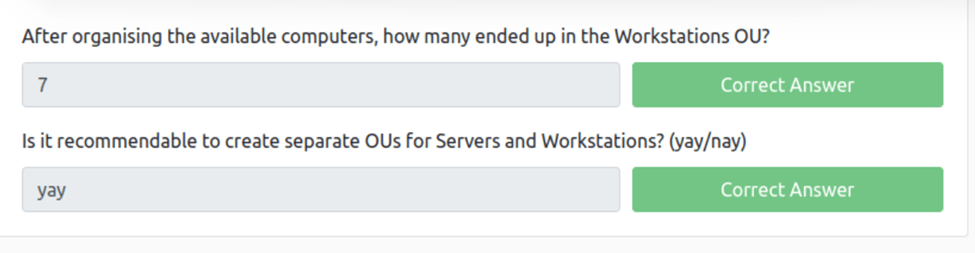
After organising the available computers, how many ended up in the Workstations OU?
First thing we need to do is orginaize the OU’s and add workstations and servers. Than we can just count how many computers are in our workstations OU, which is 7.
Is it recommendable to create separate OUs for Servers and Workstations? (yay/nay)
Yay it is recommended, because you may want different policies on the servers vs the workstations.
Task 6 Group Policies
What is the name of the network share used to distribute GPOs to domain machines?
From our reading we know that sysvol is the network share used.
Can a GPO be used to apply settings to users and computers? (yay/nay)
Again from our reading we can see that GPOs can be applied to users and computers.

Task 7 Authentication Methods
Will a current version of Windows use NetNTLM as the preferred authentication protocol by default? (yay/nay)
As we can see NetNTLM is a legacy system and Kerberos is the preferred authentication protocol so the answer is Nay
When referring to Kerberos, what type of ticket allows us to request further tickets known as TGS?
From reading we can see that the ticket granting ticket allows us to request more tickets.
When using NetNTLM, is a user’s password transmitted over the network at any point? (yay/nay)
Again, from reading it says that the passwords are never transmitted over the network. So the clear answer is Nay

Task 8 Trees, Forests, and Trusts
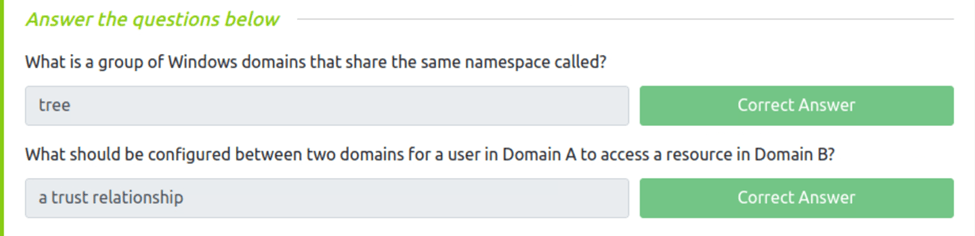
What is a group of Windows domains that share the same namespace called?
From the reading the answer is trees are a group of windows computers under a DC
What should be configured between two domains for a user in Domain A to access a resource in Domain B?
Again reading we can see a trust relationship would allow for this to happen.
Task 9 Conclusion

 R3ap3rd0g